Taking the Rivian to Off-Road School
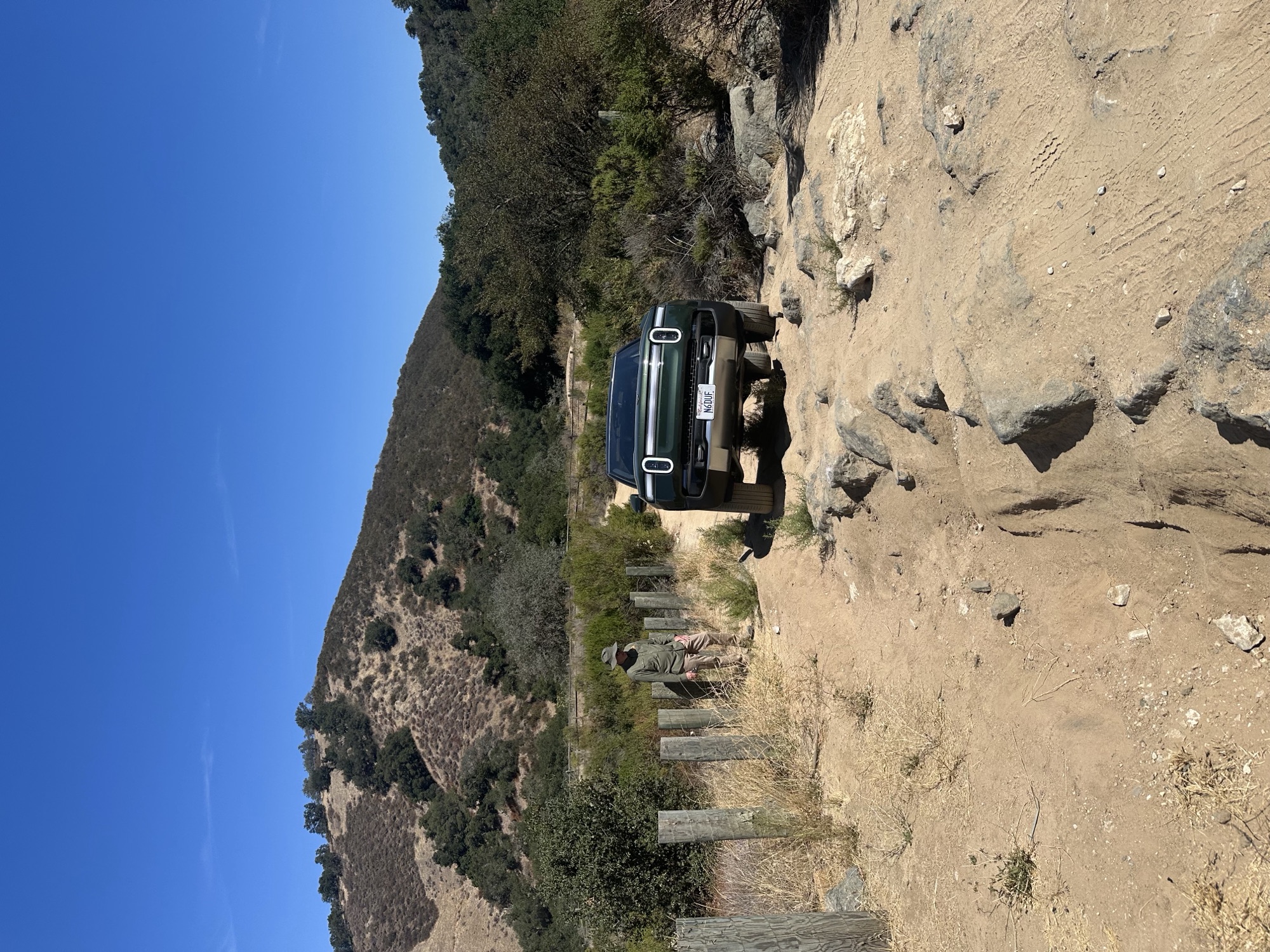
I have had my Rivian R1S for about a year now, and other than the occasional gravel parking lot, I had never taken it off the pavement. This past weekend I fixed that with The Driving Company’s civilian off-road course (a one-day class) covering 4WD operation, terrain assessment, vehicle placement, traction management, hill climbing and descending, and spotting. I wanted to actually learn how to drive my vehicle and become confident in its abilities and my own.
#Why this course
Their instructors come out of law enforcement, fire service, and search and rescue backgrounds, and the company has been training public safety agencies since 2003. Every instructor on site had literal decades of experience and I could pretty confidently say some of them had been teaching professional driving longer than I have been alive. They also explicitly welcome Rivians alongside the usual Jeeps and Broncos, which made the R1S a reasonable choice instead of an outlier. They also have Rivian only training days, but welcome them in all classes as well so I picked the date that best worked for me.
#Classroom first
The day started with about ninety minutes of classroom time before anyone touched a trail. We went through the different drivetrain systems (full-time 4x4, part-time 4x4, AWD, and independent wheel drive) and how each behaves differently off-road. The instructors were blunt about the biggest risk: rollovers are the number one cause of off-road accidents and injuries, and most of what we would spend the day learning was how to avoid them. The core idea, over and over, was that you don’t use your vehicle’s power to muscle over an obstacle. You do it smartly, or you don’t do it.
From the classroom we drove up to the Hollister Hills adventure track and started with a walk of the course. The instructors pointed out what to look for like scratched rocks as clues that someone before us had a hard time in that exact spot, obstacles to avoid, lines to take. A big part of this was learning our own vehicle’s approach and departure angles, since that determines what you can and can’t clear.
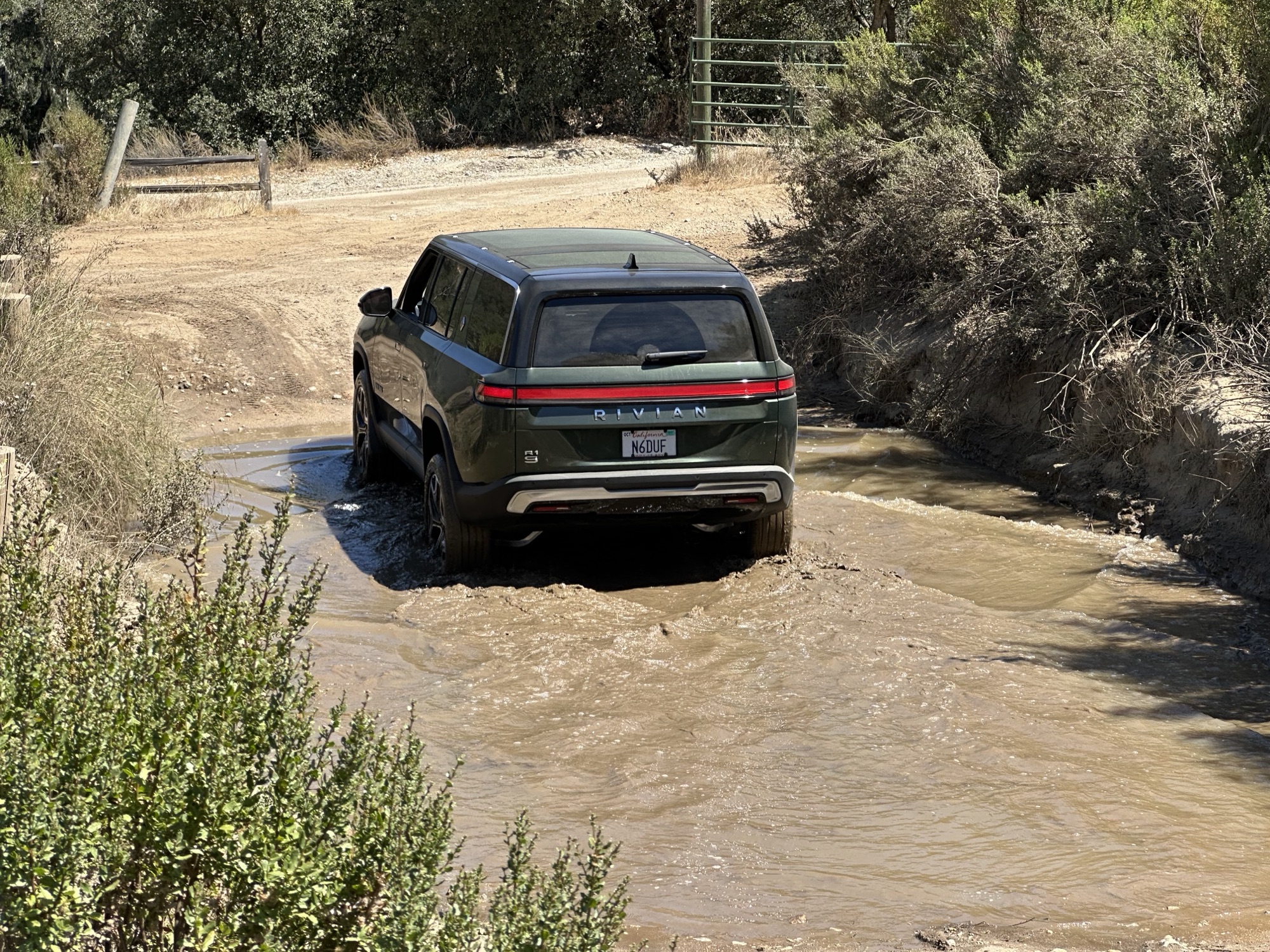
#Spotting, water, and cross-axling
I started the day spotting for a classmate rather than driving, and I think I actually preferred it that way since I got to help navigate someone else through the obstacles before doing it myself. I feel like it made the driving portion click faster.
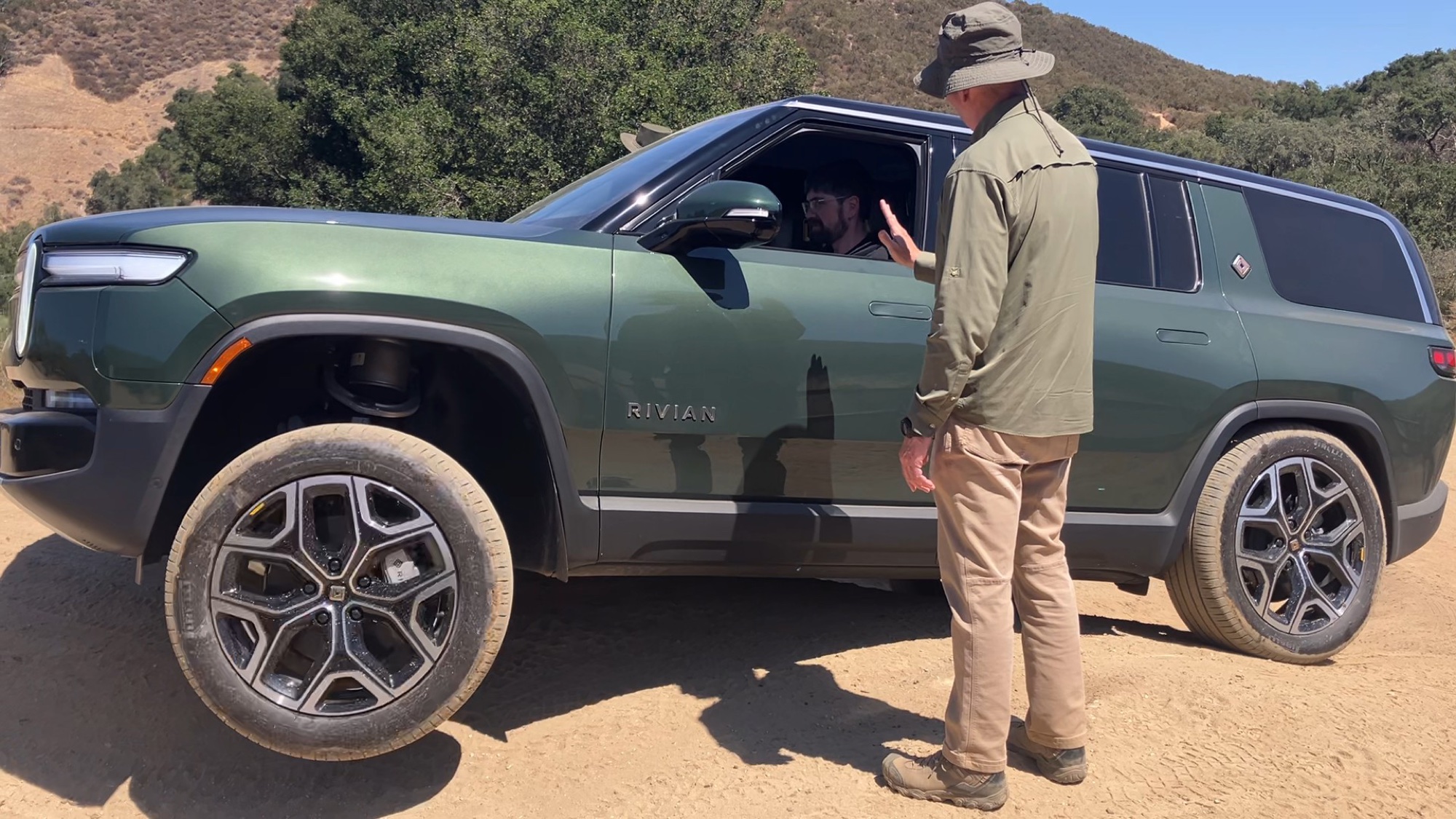
From there we deliberately cross-axled a vehicle (that’s when two diagonally opposite wheels lift off the ground at the same time) which is often harder to get out of in a 4x4 than it sounds.
Working my way out of a cross-axled position.
After that we tilted a vehicle on an incline to feel what a 20-degree side tilt actually feels like in the seat. The R1S can handle more than that, but 20 degrees is roughly the safe ceiling for most vehicles and it leaves room to absorb any sudden or unexpected movement without things getting scary.
#The rock and log climb
The most nerve-wracking part of the day for me was a rock-and-log incline, which I ran on stock road tires at standard pressure. With the amount of torque the R1S has, finding the balance between enough power to climb the obstacle and not launching over it was genuinely hard. Introducing a bit of brake while still accelerating helped a lot, but it’s a feel I want to go back and practice a lot more.
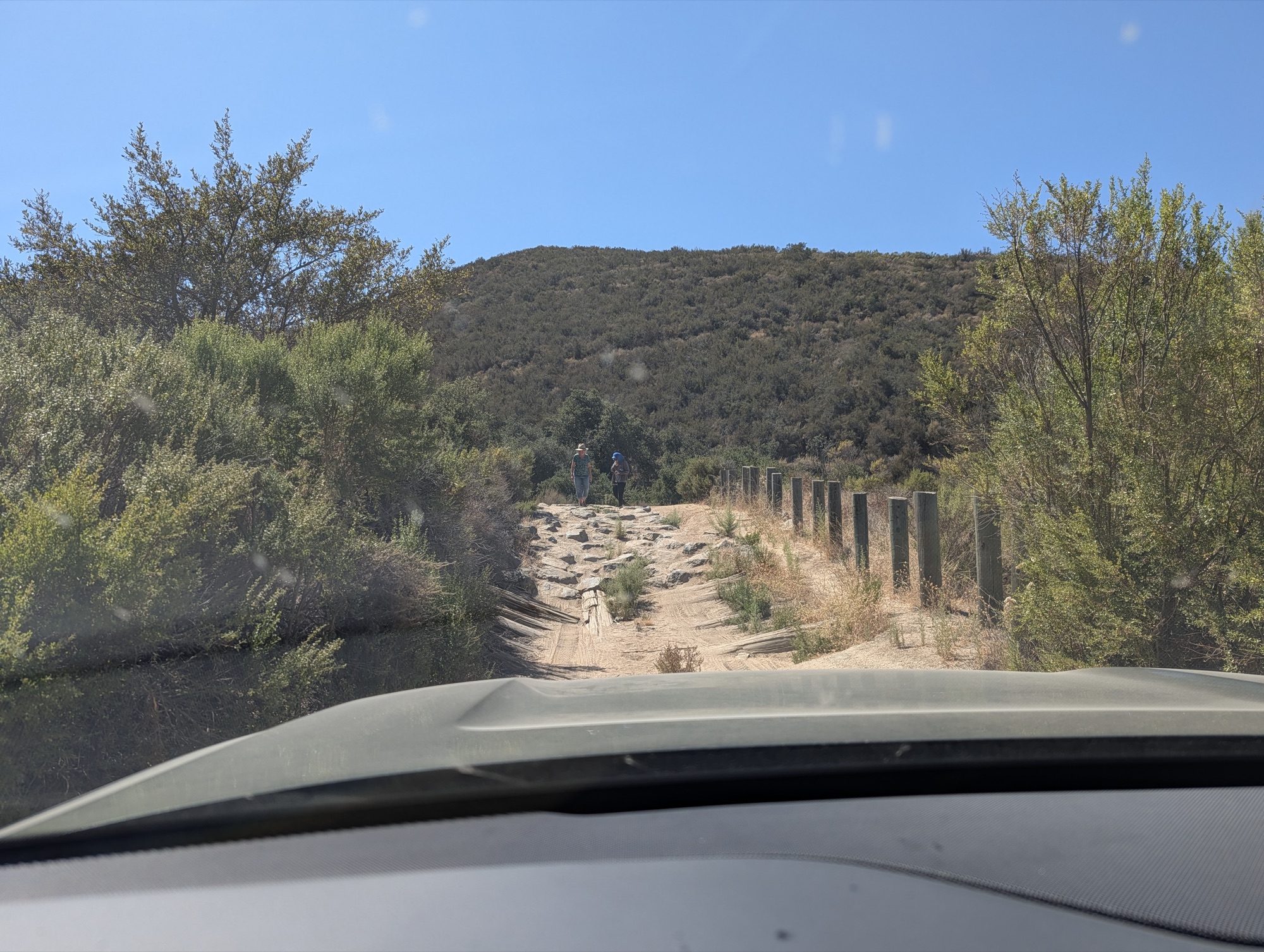
After that came the stairs, where the instructor set a water bottle on the hood and the goal was to go up and down without knocking it off. Most 4x4s can power through stairs without much thought, but that was exactly the point the instructors kept coming back to: just because you can power through something doesn’t mean you should, since it puts unnecessary stress on the vehicle.
#Aborting a hill climb
After lunch we practiced aborting a hill ascent, simulating what to do if you recognize you’ve taken on more hill than you should have, and backing out of it safely. Hills and rollovers are the most dangerous combination in off-roading, so this is the kind of thing you want in muscle memory before you ever need it for real.
One counterintuitive lesson: having regen braking on high is not what you want for this. It has too much slowing force, and I could feel the front end of the R1S wanting to pull to the side under it. We only practiced on a small hill, so there was no real rollover risk, but I could easily see how that same front-end slide becomes dangerous on a bigger hill. Tie that back to the 20-degree tilt we’d practiced earlier: if you are heading up a 30-40 degree hill, there’s no safe way to turn around and point downhill. Backing straight down is the only option. I have driven plenty of steep hills in San Francisco, but never a dirt hill where the truck can actually slide out from under you, and that’s a very different feeling.
#Bringing it together
We closed out the day with about ninety minutes of trail driving (45 minutes out, 45 back) on a single-lane road with two-way traffic that’s rated as a moderate trail at Hollister SVRA. It was a good way to string together everything from the day.
#What stuck with me
I still can’t quite believe how capable the R1S is, especially considering I did all of this on stock road tires at standard pressure without airing down. I’m looking forward to going back to practice everything we covered and building real confidence with it, and I’m seriously considering the intermediate class next. If you own something capable and have never taken it further than a gravel lot, I’d recommend a class like this to learn your limits and the vehicle’s, rather than finding them out on your own.